Science can’t prove that dark matter exists. They can’t see it or otherwise pinpoint it. Looking at all the available evidence, though, they can be fairly certain that something exists that behaves in certain ways, and so they call it dark matter and continue studying. It’s a relatively common thing in science, to deduce that there is an object or force that is causing an observed phenomenon, and to figure out the details from there. Neptune started as someone noticing strange things in the orbit of Uranus and thinking another planet could cause the anomalies.
In much the same way, my own research and observations over the past few years have always had this nagging feeling that something was off. I’ve mostly ranted about what I call passive involvement. That would then imply that active involvement is a thing. But what would “active involvement” mean? What does it take to go from a passive participant of society to an active member? Once I started thinking about this, the dark matter of community involvement that holds everything together, more and more started to make sense to me.
I’m not trying to elbow in on the territory of the communitarian philosophers, sociology, and one particular political scientist who have made the study of community their life works. These are people who generally can’t define what a community actually is, and instead focus on the overall tenets and ethics, as well as the role of the individual. This higher-level research and discussion has been incredibly helpful to me and has shaped much of my argument. It’s just not what I’m hoping to do here.
As much as I enjoy discussing such things, I’m hoping to articulate something less abstract. What I’m trying to do is put together a relatively simple framework that will help us understand why we feel so disjointed and how we can improve the community-building outcomes of our existing organizations.
The Long & Winding Road that Got Me Here
I’m not actually an academic, nor am I what is termed a professional community organizer in our modern day. What I am is a joiner. Upon reaching adulthood I found I was naturally drawn not just to volunteering, but taking leadership positions in organizations and doing the planning. I find having a job to do eases my anxiety. I’m also an entrepreneur whose ideas focus on finding new and better ways to get groups and communities together. In 2018, I started Drover and turned a critical eye on how we communicate in groups, plan events, and in general form communities. I haven’t stopped studying these connections since then.
I’m also something of a throwback. In his book Bowling Alone, Robert Putnam remarks that the so-called Silent Generation, or people who were too young to serve in WWII and too old to count as Baby Boomers, were the last great civic-minded cohort. They were the last ones to join community groups, unions, and even religious congregations in large numbers.
I bring this up because, rather unusually for someone my age, both of my parents were born in 1939. They joined the Optimists and the Travel Study Club, helped at church and volunteered for their kids’ activities. Even when not serving in leadership positions, they were always dependable volunteers. I didn’t have any aunts and uncles who lived close by, but I did have a network of adopted family consisting of the other adults involved in these organizations. In short, in many ways I grew up in the “village” we hear so much about.
I’m not going to pretend my upbringing was always perfect and that it’s the model we should all aspire to. I do, however, think it provided me with an example on how to really build a sense of community. The overwhelming feeling I’ve had for a while is that we’re trying to reinvent the wheel, convinced that the existing social structures we have are no longer applicable. Yet I know for a fact that they can provide tremendous benefits to us and society if we figure out how they best fit into our lives.
The real breakthrough came when I realized that there isn’t just one thing that’s missing. Attempts to blame individualism, technology, or economics over-simplify the problem. Thinking of my own experiences and research, I realized there are three components to Active Community Involvement. Each one occasionally gets mentioned, but it’s in understanding them better and how they work together that can help us feel more engaged.
Commitment: This is the “why”. In any group or organization, commitment is frequently what gets people in the door. They want to help dogs or make music or whatever else. Commitment can be as basic as that, or as major and individual as one’s religious or political beliefs.
Responsibility: This is the work of running the organization and maintaining one’s affiliation with them. In some cases it can be as simple as attending meetings, but as I get into more detail I’ll explain why responsibility beyond showing up is vital to helping us feel connected to our communities. We need a sense of ownership and accomplishment.
Relationships: These are the people we work with who become our friends and confidants. We see them at events on a regular basis, share the highs and lows of the group, and ultimately form incredibly strong bonds based on our joint commitment to the cause.
It’s the parts of our lives where all three components are strong and aligned that become the bedrocks of our identity and sense of belonging. The chart below illustrates how this works. Each component strengthens the others and ultimately leads to a more connected group.
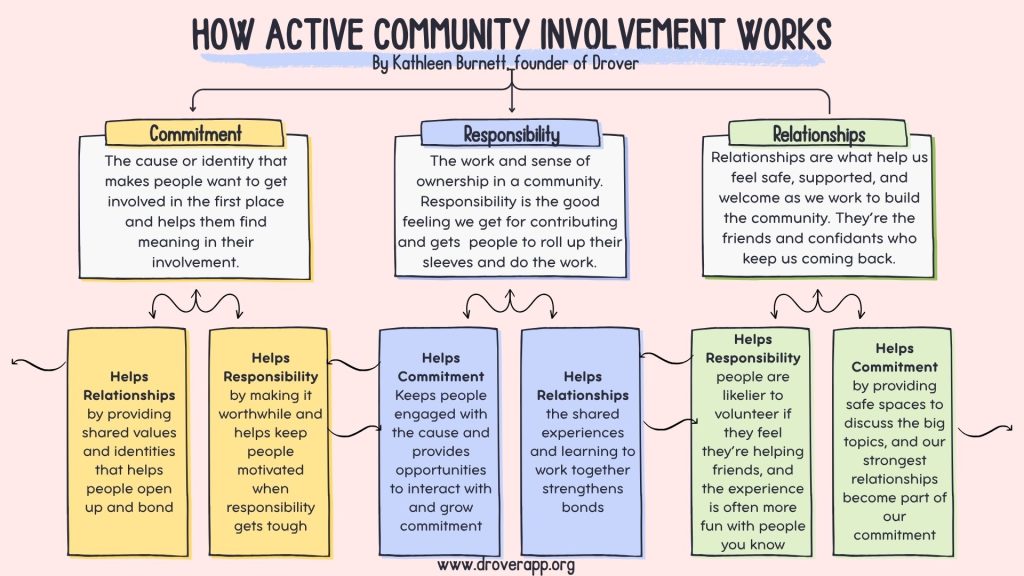
One question I’ve had for a while now is why it seemed that theater people tend to have more of a sense of community. It doesn’t matter if they haven’t been involved since high school or run a local community theater. Pondering that helped lead me to this whole idea, and also provides a great example. Everyone has a commitment to putting on a good play. Crucially, everyone has their own responsibility. From the spotlight operators to the leading actors, everyone has a job and is frequently reminded that every job is important to the success of the entire play. Old and new friends alike become better friends over the hours of rehearsals until everyone is celebrating at the party for cast & crew on closing night.
Working together on something you care about helps build strong relationships. Put that way it sounds obvious. So why are we struggling so much? Looking at each component in more detail can provide us with some clues.
Commitment
Commitment is the basis of any community. It’s the idea, belief, or identity that gets a group of people to join together. It’s what can get a person to set aside what benefits them most as an individual and work for the common good. And while philosophers, sociologists, and other thinkers have spent millennia discussing what shared values mean in a society. I’ll try to keep things simple.
In fact, commitment doesn’t automatically have to be a big, important cause. Sometimes it can be as simple as wanting to help make our local neighborhood a nicer place or wanting to celebrate your heritage. Not everything has to be about dramatically remaking the world. In fact, it might actually be better. Focusing on major global issues can lead to defeatist attitudes as much as it can motivate people. Much better to keep it simple.
At its most basic level, all commitment has to do is provide a starting point for people to begin developing relationships and be interested in taking on responsibilities. Sometimes people come into a group with a specific responsibility or relationship already established, but generally it’s the cause that brings them in the door.
Because no two people come to a cause for the exact same reasons, it’s important to allow for individual differences. Some people might be extremely well-versed in the topic and some might have just a passing curiosity. Some might not even be on board yet, having been dragged to a meeting by a friend or family member. That’s where providing simple reminders of the why and opportunities for in-depth discussion are both important.
Some of the traditions of long-time organizations are there to help reaffirm and keep commitment at the top of people’s minds. Rituals and customs have gone out of fashion, but they can serve an important purpose. So too can discussion-based events, which can help people learn about their own commitment and the interpretations their fellow members have.
Responsibility
Responsibility can take many names. Membership. Involvement. Volunteering. Every group has tasks that need doing just to keep the group going and ways to help people feel like part of the group. Responsibility is all of that, giving people an opportunity to act on their commitment and feel a sense of accomplishment as they help the cause along.
When we tell people they can be involved without any real responsibility, we’re doing them and our organizations a disservice. Giving people responsibility besides just showing up is how they feel like part of the team and like they’re helping the cause they’re committed to. It’s how we build new skills and develop a real sense of pride in our accomplishments. Crucially, it’s also how some of the best relationships are formed, working on responsibilities together. All of these provide the warm-fuzzies that keep people coming back.
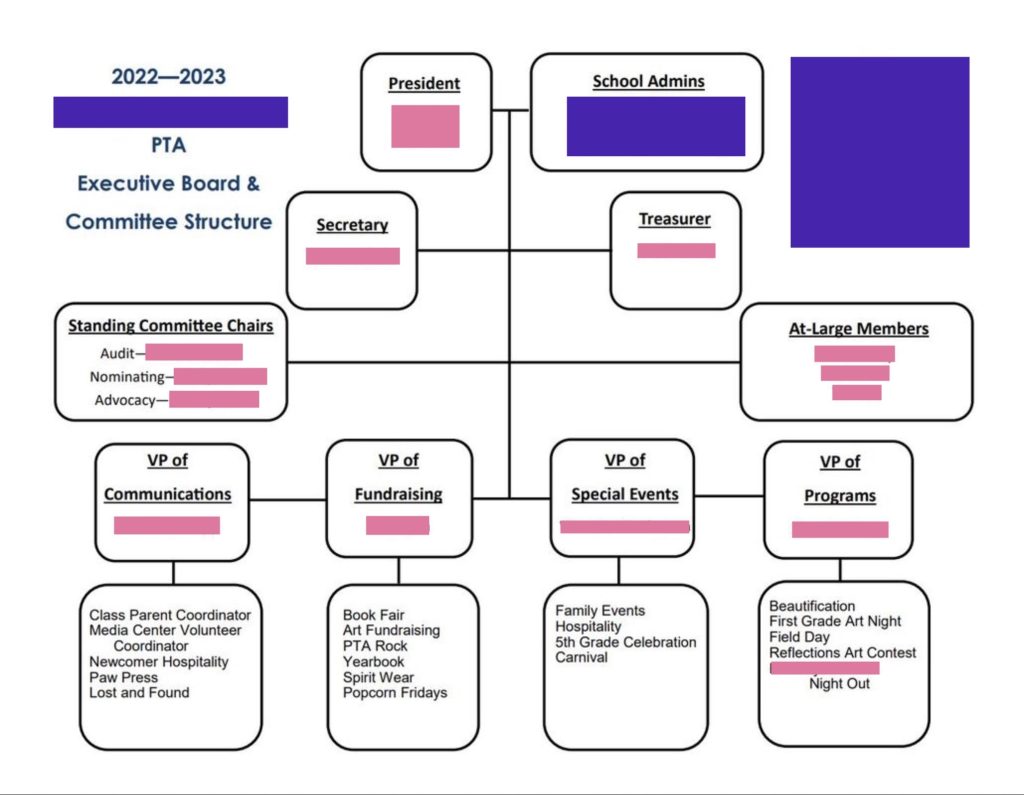
Below is an org chart for an elementary school PTA. Each pink box represents the name of someone who doesn’t just volunteer, they are responsible for the ongoing activities of the group. (That’s not counting all the committees listed at the bottom, which probably have chairs but aren’t named.) People can try different areas to find something that fits their interests or provide more or less of a time commitment. Crucially, it represents a network of people who form relationships. Some relationships might become life-long friends. Others will be a lesson in conflict resolution. It’s all part of learning and growing.
In recent years avoiding such responsibility has become something to be proud of, but I don’t see it that way. Being willing to give your time, however little you have, is a powerful source of fulfillment. It might take some trial and error or have times when it feels difficult, but whatever effort we can put in compounds into a greater sense of belonging.
The key thing with responsibility is that both organizers and volunteers need to remember the adage about many hands making light work. There needs to be small tasks and other ways for people to be involved that don’t require massive amounts of time. Taking on responsibility isn’t something to be afraid of, though. Whatever you can do will probably be of help, and may lead you down new, life-changing paths you wouldn’t have encountered otherwise.
Relationships
All of this leads to relationships. If we spend time with like-minded people, working on projects and helping to keep an organization going, we’re likely to develop extremely strong friendships.
When we stress about ways to combat loneliness, it’s important to remember that shared experiences and commitment are what really bring people together.
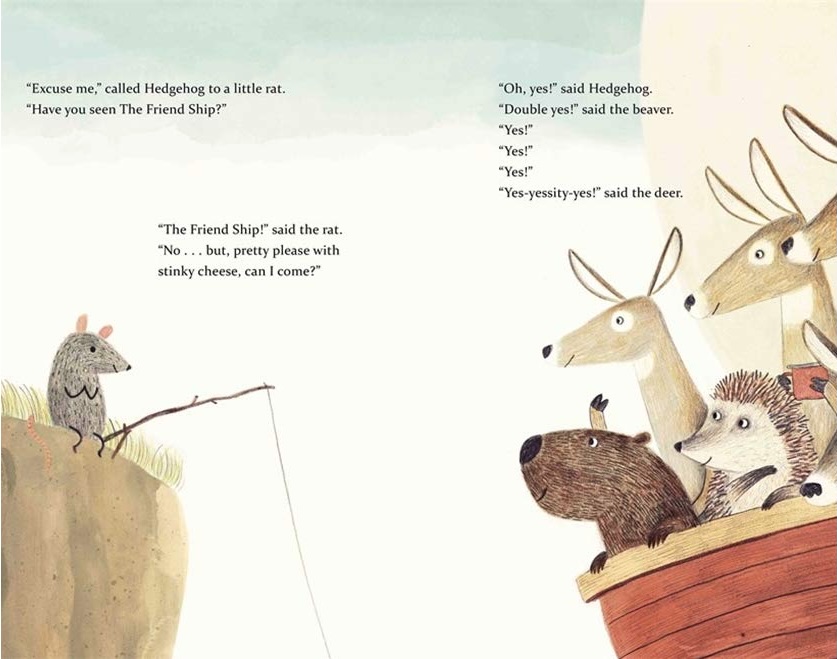
I recently bought a book for my preschooler called The Friend Ship. In it, a lonely hedgehog imagines a magical ship cruising the seas that is full of great friends. She decides to set sail in search of it. Along the way, other animals ask to join her on the quest since they too would like to find the friend ship. Eventually they realize that they are a ship cruising the seas full of great friends. I love how it reminds me that friendship isn’t a specific place, it’s a destination often reached by working together with others. It’s also a great illustration of what I mean about relationships.
It’s an accepted fact that it can be hard to make friends as an adult. Is it, or are we just not as involved? Very few of us go out and try to find other places where we share responsibilities and have a commitment to some cause in a way that helps forge relationships. We can’t go to one-off events or workshops and expect to immediately make friends with people. Maybe eventually, after a couple of happy hours and a coffee date, we’ll get there. Consistent community involvement is a much more effective way to build relationships.
There are steps organizations can take to help facilitate these relationships, too. Welcoming newcomers in a friendly but authentic way is important. Once people are there, providing regular events that allow ample social time helps facilitate relationships. Personally I’m a big believer in the after-meeting drinks as a way to bond with others. If you’re an organizer, make sure you have a coffee shop or bar to adjourn to, and if you’re a volunteer, make time to go.
Something’s Missing
Modern society is full of opportunities that embrace one, maybe two, of the components and leave the others untouched. Single-day park cleanups may make us feel better about our commitment to the community and environment, but they’re unlikely to provide lasting relationships or give us much of a sense of ownership. Likewise a regular book club might help you make a few friends and give you a chance to talk about some of the things that matter to you, yet without any real responsibility it’s never going to be something that leaves you feeling fulfilled.
I recently read a blog post written by a professional political activist in which he shares his organization’s experience helping others plan town halls in their local communities. I can’t help but feel like he took the wrong lesson from their success. He claims that it was leadership’s clear instructions to their volunteers that made the difference. Certainly having resources and people to ask questions helped. I don’t want to discount that.
I got the sense that the really important lesson was that these were people who had been given a responsibility in their local communities that they felt committed to. They formed strong enough relationships with each other that they were able to stick together when things were difficult and keep going. They felt pride and ownership in their accomplishments and what it means to their cause and were able to celebrate that victory together. That looks like the framework in action to me.
The Hard Work Is Just Beginning
You’re probably expecting me to be able to give some kind of simple and pithy advice now on how to make this framework applicable in your life. Five easy steps to Active Community Involvement or whatever. But that’s just not how it can work.
It’s going to take a process of unlearning decades of conventional wisdom that being involved in community groups takes too much time, is full of self-important people you could never be friends with, and somehow invalidates our importance as an individual. All for something that doesn’t even make any real difference to the world.
But it’s worth it. Think of our community not as a structure that needs built, but an ecosystem in which every part depends on all the others. From the tiniest microbe to the tallest tree, each organism in the environment works together and builds on each others strengths and weaknesses to make the whole strong. I believe that once we realize we’re all part of an ecosystem we’ll all thrive. It’s my hope that my Active Community Involvement framework can help more people grasp how rewarding it is if we’re all more interconnected.
Years of consumerism and the advent of the self-empowerment movement, which both had gasoline poured on them by social media, have convinced us that every problem can be solved by buying something new or focusing more on what makes you as an individual happy.
But we’re not, are we?
So the next time you’re trying to decide if you have time to get involved in an organization or you’re tempted to go to yet another happy hour networking event, keep this framework in mind. Try finding ways to really be active in your community instead of a passive participant. See if that might help you out instead of trying the same balms of consuming goods and content.
Know that it takes time, and not everything is going to be perfect. Like dark matter and the universe, though, our active involvement is the glue that hold society together. And the more active we are, the stronger our communities will become.


1 Comment
All About Commitment – Drover · August 27, 2026 at 6:20 pm
[…] Click here to read the introduction to active community involvement […]